

The first time you go through a neobank compliance audit, you expect it to be technical. You expect documents, checklists, maybe a few tense calls with auditors. What you don’t expect is how deeply it exposes the inner workings of your organization—how decisions were made, where shortcuts were taken, and which assumptions quietly shaped your systems.
My first audit wasn’t just a regulatory milestone. It was a turning point. It forced me to look beyond policies and see how compliance actually lives (or fails to live) inside a digital financial product. What follows are six lessons that stayed with me long after the audit ended—lessons that reshaped how I think about risk, operations, and trust.
These aren’t abstract ideas. They come from real friction points, unexpected findings, and those uncomfortable moments when an auditor pauses, looks up, and asks a question you didn’t prepare for.
Lesson 1: Documentation is not a formality—it is your defense
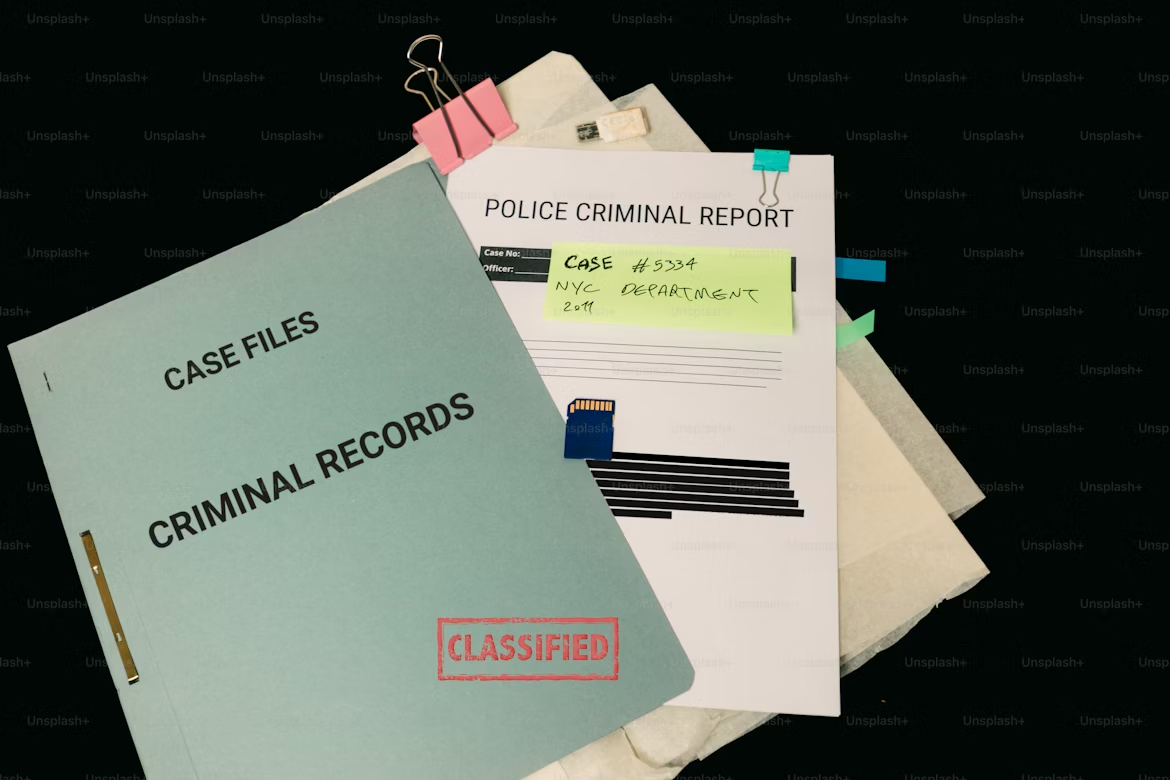
Before the audit, I thought we were well-prepared. We had policies, procedures, onboarding flows, and internal guidelines. Everything existed somewhere. That, I assumed, was enough.
It wasn’t.
The first thing auditors look for is not just whether you follow a process—but whether you can prove it. Documentation is the evidence layer of compliance. Without it, even a well-functioning system appears unreliable.
We quickly discovered gaps:
- Procedures that were followed but never formally written down
- Policies that existed but hadn’t been updated in months
- Decisions made in meetings but never recorded
The audit made it clear: if it’s not documented, it doesn’t exist.
Informational Table: Documentation Maturity Levels
| Level | Description | Audit Impact |
|---|---|---|
| Basic | Scattered documents, inconsistent updates | High risk of findings |
| Intermediate | Centralized policies, occasional gaps | Moderate audit pressure |
| Advanced | Version-controlled, regularly reviewed | Smooth audit experience |
| Optimized | Fully integrated with workflows and systems | Minimal audit friction |
One practical change we made afterward was implementing version control for all compliance documents. Every policy had an owner, a review cycle, and a change log. It sounds simple, but it transformed how confidently we could respond to audit requests.
Lesson 2: KYC is only as strong as its weakest edge case
Our onboarding process looked solid on paper. Automated identity verification, document scanning, and biometric checks—all the standard components were there.
Then the auditors started digging into edge cases.
What happens when a user’s document is partially unreadable?
How do you handle mismatched addresses?
What if biometric verification fails but the user retries multiple times?
These weren’t hypothetical questions. They were real scenarios, and in some cases, our responses weren’t consistent.
The biggest insight was that compliance doesn’t break in the main flow—it breaks at the edges.
Informational Chart: KYC Weak Points
| Scenario | Risk Level | Common Failure | Recommended Fix |
|---|---|---|---|
| Incomplete ID upload | High | Manual override without logs | Enforce rejection rules |
| Address mismatch | Medium | Inconsistent verification | Standardized validation logic |
| Biometric retry loops | High | Unlimited attempts | Retry limits + escalation |
| Cross-border applicants | High | Lack of enhanced checks | Geo-specific KYC rules |
We introduced stricter fallback procedures. If automation failed, manual review had to follow clearly defined steps, with every decision logged. That reduced ambiguity and made our process auditable.
Lesson 3: Transaction monitoring is not about alerts—it’s about interpretation
Before the audit, we were proud of our transaction monitoring system. It generated alerts based on predefined rules and risk thresholds. We assumed that more alerts meant better coverage.
The auditors saw it differently.
They asked:
How many alerts are false positives?
How quickly are they reviewed?
What actions are taken after review?
We realized that generating alerts is only the beginning. What matters is how those alerts are interpreted and resolved.
Informational Table: Alert Handling Efficiency
| Metric | Before Audit | After Improvements |
|---|---|---|
| Daily alerts generated | 1,200 | 850 |
| False positive rate | 78% | 42% |
| Average review time | 36 hours | 12 hours |
| Escalation consistency | Low | High |
We reduced noise by refining our rules and introduced a tiered review system. Low-risk alerts were handled automatically, while high-risk ones were escalated to trained analysts.
The key lesson: a smaller number of meaningful alerts is far more valuable than a flood of irrelevant ones.
Lesson 4: Data privacy is a moving target
We believed we had strong data protection practices. Encryption was in place, access controls were defined, and privacy policies were published.
But the audit revealed something subtle: compliance is not static.
Regulations evolve. User expectations change. New risks emerge.
One finding highlighted that some user data was retained longer than necessary. Another pointed out that access logs were not reviewed regularly.
Informational Chart: Data Lifecycle Risks
| Stage | Risk Example | Mitigation Strategy |
|---|---|---|
| Collection | Excessive data fields | Data minimization |
| Storage | Weak encryption standards | Strong encryption protocols |
| Access | Over-permissioned roles | Role-based access control |
| Retention | Data kept beyond required period | Automated deletion policies |
We implemented automated retention rules and scheduled quarterly access reviews. These changes didn’t just satisfy auditors—they reduced our overall risk exposure.
Lesson 5: Culture matters more than tools
This was the most unexpected lesson.
We had invested in compliance tools—monitoring systems, verification software, reporting dashboards. But the audit showed that tools alone are not enough.
In some cases, employees didn’t fully understand why certain procedures existed. In others, compliance tasks were treated as secondary to growth goals.
The auditors weren’t just evaluating systems; they were evaluating behavior.
Informational Table: Compliance Culture Indicators
| Indicator | Weak Culture | Strong Culture |
|---|---|---|
| Training frequency | One-time onboarding | Continuous learning |
| Policy awareness | Limited | Organization-wide |
| Incident reporting | Hesitant | Encouraged and transparent |
| Leadership involvement | Minimal | Active and visible |
After the audit, we introduced regular training sessions and made compliance metrics part of team performance reviews. Over time, this shifted the mindset from “compliance as a burden” to “compliance as a shared responsibility.”
Lesson 6: Audits are not the end—they are feedback loops
Going into the audit, I saw it as a test. Pass or fail. A one-time event.
By the end, I understood it differently.
An audit is a snapshot. It shows where you are at a specific moment, but its real value lies in what you do afterward.
The findings we received were not just criticisms—they were insights. Each one pointed to an opportunity to improve.
Informational Chart: Audit Response Framework
| Phase | Action | Outcome |
|---|---|---|
| Review | Analyze audit findings | Clear understanding |
| Prioritize | Rank issues by risk | Focused action plan |
| Implement | Apply corrective measures | Risk reduction |
| Monitor | Track improvements | Continuous compliance |
We created a post-audit roadmap with timelines and ownership for each action item. More importantly, we treated it as a living document, updating it as new risks emerged.
Bringing the lessons together
Each of these lessons connects to a broader truth: compliance is not a checklist. It’s a system made up of processes, people, and technology.
Here’s how the six lessons align:
| Lesson | Core Insight | Long-Term Impact |
|---|---|---|
| Documentation | Evidence matters | Audit readiness |
| KYC edge cases | Details define strength | Reduced onboarding risk |
| Alert interpretation | Quality over quantity | Efficient monitoring |
| Data privacy | Continuous adaptation | Stronger data protection |
| Culture | People drive compliance | Sustainable practices |
| Audit mindset | Learn, don’t just pass | Ongoing improvement |
Looking back, the audit didn’t just evaluate our compliance posture—it reshaped it. It forced us to confront weaknesses we hadn’t noticed and refine systems we thought were already strong.
Frequently Asked Questions (FAQs)
- What is the main purpose of a neobank compliance audit?
A compliance audit evaluates whether a neobank is adhering to regulatory requirements, internal policies, and industry standards. It helps identify risks, gaps, and areas for improvement. - How long does a typical compliance audit take?
The duration varies depending on the size and complexity of the neobank, but it can range from a few weeks to several months, including preparation and follow-up actions. - What are the most common audit findings?
Common findings include incomplete documentation, inconsistent KYC procedures, weak transaction monitoring processes, and gaps in data protection practices. - How can a neobank prepare for its first audit?
Preparation involves organizing documentation, reviewing policies, testing systems, training staff, and conducting internal audits to identify potential issues beforehand. - Are compliance tools enough to pass an audit?
No, tools are only part of the solution. Auditors also assess processes, decision-making, and organizational culture. - What should be done after an audit is completed?
Neobanks should analyze findings, implement corrective actions, monitor progress, and treat the audit as a continuous improvement opportunity rather than a one-time event.
In the end, the first compliance audit is less about proving you’re perfect and more about understanding where you’re not. That realization, uncomfortable as it may be, is what ultimately drives growth.