


Let me tell you about a Tuesday afternoon that nearly gave me a full-blown anxiety attack.
I was sitting across from our external auditor — coffee going cold, spreadsheets sprawled across two monitors — and she casually asked for a reconciled transaction log going back 18 months. For three different accounts. By end of day.
I had bits of it. In three different formats. Across two tools that didn’t talk to each other.
That was the moment I stopped treating financial compliance as something you “get to eventually” and started taking audit tooling seriously. Since then, I’ve tested, broken, and actually relied on a handful of tools that made the whole process less of a fire drill.
Here are five that genuinely work — not because a product page said so, but because I’ve watched them perform under pressure.
1. Workiva — For Teams That Need a Single Source of Truth
The first time I used Workiva, I was skeptical. It looked like another flashy dashboard that promised the world and delivered a PDF export. But after about two weeks of actual use, I got it.
Workiva connects your financial data, narrative reporting, and compliance documentation in one place. When a number changes in your source data, it updates everywhere it appears — in your reports, your disclosures, your audit trail. No more hunting down which version of the spreadsheet someone emailed last Thursday.
Where it really earns its keep:
- SOX compliance documentation
- Multi-entity financial consolidation
- Board and audit committee reporting
The audit trail functionality is genuinely impressive. Every change is logged with a timestamp and user ID. When our auditor asked “who changed this figure and when,” I had the answer in about 30 seconds. That kind of moment is worth the subscription cost alone.
One honest downside: the learning curve is steeper than they’ll admit in the sales call. Give your team a proper onboarding period. Don’t just throw people in and hope for the best — I made that mistake and spent a week untangling inconsistent tagging.
2. AuditBoard — If You’re Managing Multiple Compliance Frameworks at Once
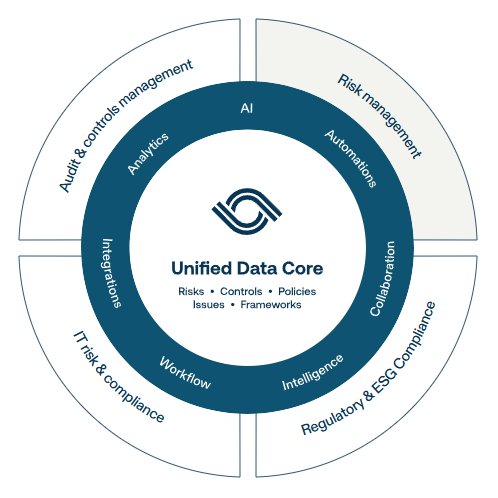
If your organization has to juggle SOC 2, ISO 27001, GDPR, and maybe a sector-specific regulation on top of that — AuditBoard is the tool I’d hand you without hesitation.
The thing about multi-framework compliance is that it looks scarier than it is once you have proper tooling. Most controls overlap between frameworks. AuditBoard maps those overlaps, so instead of documenting the same control five times for five different audits, you document it once and link it across frameworks.
I remember the first time we ran a cross-mapped control assessment. We were expecting weeks of work. It took four days. That’s not hyperbole — it genuinely compressed the timeline.
| Feature | AuditBoard | Manual Process |
|---|---|---|
| Control mapping (multi-framework) | Automated | Weeks of spreadsheet work |
| Evidence collection | Centralized request portal | Email threads + shared drives |
| Audit status visibility | Real-time dashboard | Status meetings + guesswork |
| Issue tracking | Built-in workflow | Separate project management tool |
Practical tip: Use their “request management” feature aggressively. Instead of chasing people over email for evidence, you send a formal request through the platform. It creates accountability and timestamps everything. Auditors love it.
If you’re exploring digital-first compliance approaches — particularly for neobanks and digital finance platforms — you’d find strong parallels in 9 Digital Wallet Neobank Security Audits to Protect Your Money, which covers audit concepts that translate well beyond just wallets.
3. BlackLine — Specifically for Financial Close and Reconciliation
This one has a narrower focus, which is exactly why it works so well.
BlackLine is built around one painful, recurring nightmare: the financial close process. Month-end, quarter-end, year-end — that brutal stretch where the finance team disappears into a cave and emerges three weeks later looking slightly haunted.
What BlackLine does is automate and organize the reconciliation process. Every account that needs to be reconciled has its own workflow. Preparer completes it, reviewer approves it, discrepancies are flagged automatically. Nothing falls through the cracks because the system won’t let you close out an account that hasn’t been signed off.
Real scenario: Before BlackLine, our month-end close took 12 business days average. After six months on the platform, we were consistently hitting 7. That difference is enormous when you’re trying to report timely financials to investors or a board.
Things to watch out for:
- The initial data migration is time-consuming. Budget more time than you think you’ll need.
- The matching rules for automated reconciliation need tuning for your specific transaction types. Out of the box, they’re decent — but customized, they’re genuinely powerful.
- Make sure your ERP integration is solid before you go live. A shaky integration means bad data flowing into your reconciliations, which defeats the purpose entirely.
BlackLine works best as a long-term investment, not a quick fix. The first 90 days feel like you’re doing more work, not less. Push through that phase — it pays off.
4. Vanta — The Fastest Path to SOC 2 Compliance I’ve Seen
Okay, this one I have a genuinely strong opinion about.
If you’re a startup or a scaling company that needs to hit SOC 2 Type II — and increasingly, enterprise customers are requiring it before they’ll sign — Vanta is the most practical tool available right now.
Here’s the thing about SOC 2 that no one tells you until you’re in it: the evidence collection process is relentless. Auditors don’t just want your policy documents. They want proof that the policies are being followed, consistently, over time. Logs, screenshots, configurations — hundreds of them.
Vanta automates a huge chunk of that evidence gathering. It integrates with your cloud infrastructure (AWS, GCP, Azure), your identity providers, your HR systems, your code repositories — and continuously pulls evidence that your controls are operating. When your audit window comes around, a significant portion of the evidence is already collected.
Where it helped us most:
- Access control evidence (who has access to what, and is it appropriate?)
- Encryption-at-rest and in-transit verification
- Vendor risk management
- Security awareness training tracking
The compliance dashboard gives you a live “readiness score” — which honestly becomes a bit addictive to watch tick upward as you remediate gaps.
Limitation worth mentioning: Vanta is great at breadth but sometimes thin on depth. For highly complex or regulated financial environments, you’ll still need human judgment layered on top. It’s a powerful accelerator, not a replacement for a qualified compliance team.
This overlaps interestingly with emerging standards in digital finance. The 11 Best Neobank Digital Wallet Security Audits for Maximum Safety covers several audit dimensions that align closely with what Vanta automates — worth a read if you’re operating in fintech.
5. Diligent (formerly ACL / Galvanize) — For Deep Data Analytics in Audit
This is the one that tends to surprise people.
Most compliance tools are about organizing your process. Diligent is about analyzing your data. There’s a meaningful difference, and for internal audit teams specifically, it matters a lot.
Diligent (their audit analytics platform, built on what was originally ACL Analytics) lets you run queries across large financial datasets to identify anomalies, duplicates, gaps, and outliers — the kind of stuff that signals either error or fraud.
Common use cases:
- Duplicate payment detection (this one alone has recovered real money for organizations)
- Continuous controls monitoring on accounts payable
- Population testing vs. traditional sampling
- Segregation of duties conflict analysis
The jump in audit coverage is significant. Traditional sampling might give you 5-10% coverage of a transaction population. Continuous monitoring with Diligent can get you to 100% population testing. For a compliance or internal audit function, that’s transformative.
| Testing Method | Population Coverage | Time Required |
|---|---|---|
| Manual sampling (traditional) | 5–10% | High |
| Automated sampling (tool-assisted) | 20–30% | Medium |
| Continuous monitoring (Diligent) | Up to 100% | Low (once configured) |
Honest take on the learning curve: This tool has more complexity than the others on this list. The scripting language (ACLScript) takes time to learn properly. If you don’t have someone on your team with data analytics background, plan for training or consider bringing in a consultant for initial setup.
But once it’s running? It’s like having an audit team that never sleeps and never misses a transaction.
If you’re curious how audit analytics principles apply to digital banking contexts, 10 Must-Do Neobank Digital Wallet Security Audits for Risk Mitigation explores similar risk-based thinking in a digital-first environment.
Common Mistakes People Make When Implementing Audit Tools
After watching teams adopt and sometimes abandon these tools, a few patterns emerge.
Mistake 1: Treating the tool as the solution rather than the enabler. No software fixes a broken compliance process. If your underlying controls are weak, the tool will just help you document them more efficiently — which actually makes the problem more visible, not less. Fix your process first, then automate it.
Mistake 2: Underestimating the implementation timeline. Every single one of these tools takes longer to implement than the vendor’s estimate. Double it. Seriously. Budget the time and internal resources accordingly.
Mistake 3: Not involving the actual users in tool selection. I’ve seen this go wrong multiple times. The finance director picks a tool. The team that has to use it every day had no input. Adoption suffers, workarounds multiply, and you’re back to spreadsheets within six months.
Mistake 4: Skipping the integration audit. Your compliance tool is only as good as the data feeding into it. Before going live, spend serious time validating that your integrations are pulling accurate, complete, and timely data.
Mistake 5: Ignoring ongoing maintenance. These platforms evolve. Regulatory requirements change. Someone needs to own the tool and keep it aligned with what your organization actually needs. Set that ownership clearly on day one.
A Quick Guide to Choosing the Right Tool for Your Situation
Not every tool fits every situation. Here’s a simplified decision framework based on what I’ve seen work:
If you’re a startup going for SOC 2 for the first time → Start with Vanta. It’s the fastest path with the least friction.
If you’re a mid-market company managing multiple regulatory frameworks → AuditBoard handles complexity better than most.
If your pain point is month-end close and reconciliation → BlackLine is purpose-built for exactly that.
If you’re an internal audit team that wants to test full populations rather than samples → Diligent’s analytics capabilities are worth the investment.
If you need enterprise-grade financial reporting and disclosure management → Workiva connects narrative and numbers in a way nothing else quite matches.
These aren’t mutually exclusive either. Larger organizations often run two or three of these in tandem — Vanta for continuous compliance monitoring, AuditBoard for audit management, and BlackLine for the financial close. They serve genuinely different functions.
Final Thoughts
Financial compliance doesn’t have to be the thing that makes everyone on the finance team visibly anxious every quarter. The right tooling genuinely changes the dynamic — not by eliminating the work, but by making it manageable, trackable, and a lot less dependent on heroic individual effort the night before a deadline.
Start with the problem you feel most acutely right now. Pick one tool. Get it implemented properly before adding another. And remember that the goal isn’t to have impressive software — it’s to have a compliance posture you can actually stand behind when an auditor walks in the door.
That Tuesday afternoon with the cold coffee taught me that. The tools I’ve listed here are the ones that helped me make sure it never happened again.