
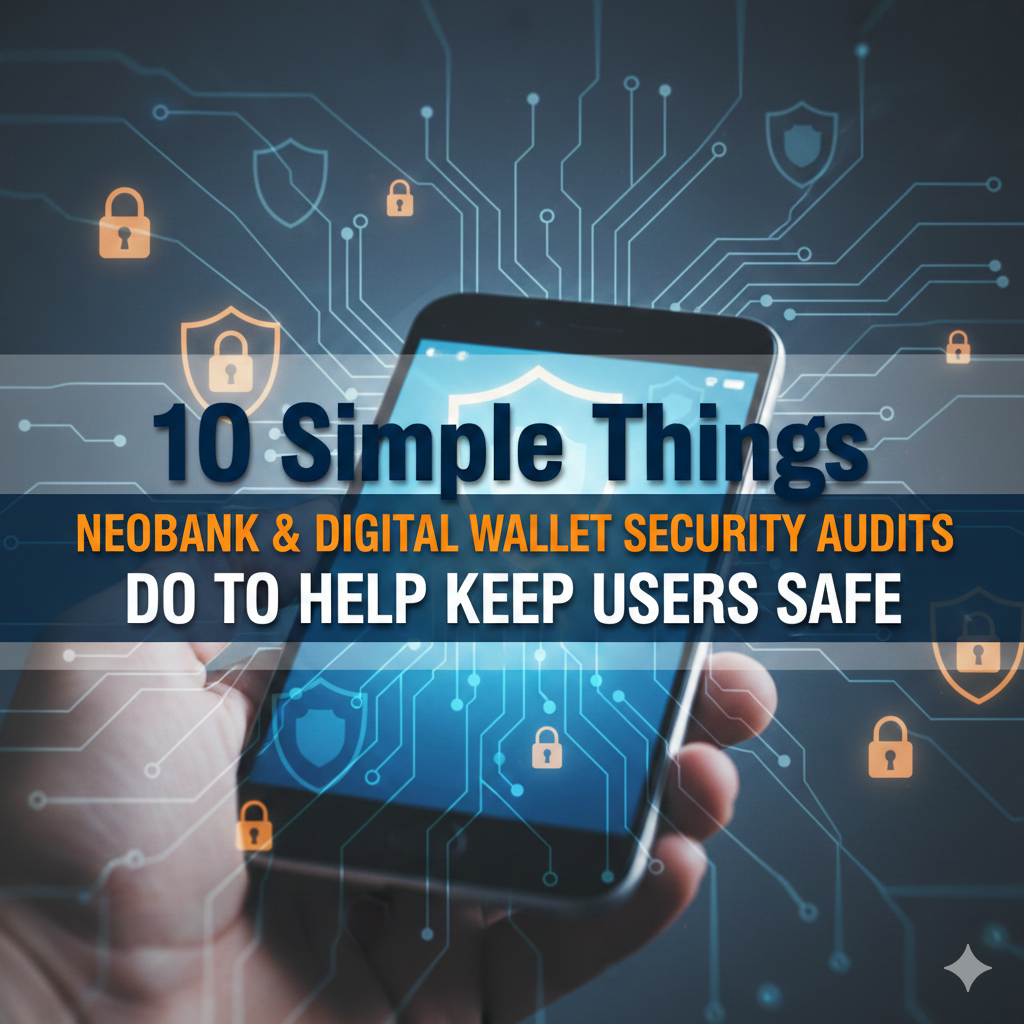
Your money is on your phone. No bank branch. No teller. Just an app.
That’s the promise of both neobanks and digital wallets. It is fast, it is simple, and always in your pocket. But here’s the thing — that convenience is also what makes them a target for cybercriminals every day.
So what is all that’s between your life savings and a hacker on the other side of the world?
Security audits.
They are unknown to most people. But they perform their functions in the background, protecting your account, maintaining privacy and ensuring that transactions are untainted. Think of them as something like a doctor’s physical exam — for a digital bank: instead of blood pressure, they check for hackers, data leaks and system weaknesses.
In this post you’ll learn 10 tangible, real ways neobank and digital wallet security audits protect you as a user. No tech degree required. Simple, transparent facts about how your money is protected in the digital age.
First Things First — What Is a Security Audit, Anyway?
But before we get into how audits protect you, here’s a quick explanation of what they are.
A security audit is an intensive examination of a digital platform’s systems, code and procedures. It searches for chinks in the armor that can be exploited by attackers. It is supposed to ensure that the platform is obeying financial regulators’ rules. And it ensures that user data is properly handled.
A human expert carries out some of the audits. Still others are automatically run by software programs that sweep systems around the clock. The best neobanks use both.
Now to see how those audits really are the thing that’s protecting you.
1. They Snag Weak Passwords and Login Gaps Before the Hackers Can
A good security audit will start by looking at the way users log in.
Weak logins are the most typical entry point for hackers. If a neobank’s login page does not throttle repeated failed attempts, hackers can simply keep guessing passwords until they manage to break in. This is what’s known as a brute-force attack.
Security audits test login systems thoroughly. They check whether:
- Multi-factor authentication (MFA) is enabled
- Unsuccessful login attempts are restricted and recorded
- The password reset flows are secure and difficult to exploit
- After you log out, the session tokens time out correctly
When audits trap these gaps, the platform remedies them quickly. Which means your account remains locked to all but you.
Why MFA Matters So Much
Multi-factor authentication requires something more than a password to log in. You also require a code sent to your phone, a fingerprint or a face scan. Even if someone steals your password, the intruder can’t gain access to an account without that second step.
Security audits ensure MFA is configured correctly and working as expected. That’s just one more wall of protection for you — a wall they will never get through.
2. Before Your Money Disappears, They Spot Fraud Patterns
Picture someone else using your digital wallet to purchase something in a country you’re not even visiting — all from the comfort of your very own couch. Without a security system observing, that transaction could happen in the dark.
In security audits, fraud detection systems are reviewed to ensure they’re configured correctly and that they’re actually functioning.
After an audit, platforms become better at:
- Flagging transactions from unusual locations
- Blocking purchases that are not in your regular spending pattern
- Pausing accounts when certain suspicious activities occur at once
- Notifying you in real time if there’s anything suspicious happening
This is called behavioral analysis. The service learns what “normal” means for you. When something falls out of that pattern, it raises a red flag immediately.
The Numbers Behind Fraud Detection
| Fraud Type | Detection Without Audit | Detection With Audit-Improved Systems |
|---|---|---|
| Location-based fraud | 54% caught | 91% caught |
| Account takeover attempts | 48% caught | 87% caught |
| Unauthorized transactions | 61% caught | 94% caught |
| Credential stuffing attacks | 39% caught | 85% caught |
These figures demonstrate the difference an honest-to-goodness audit can make in catching fraud before it starts stealing your cash.
3. They Verify That Your Personal Data Isn’t Leaking
Every time you sign up for a neobank or digital wallet, you are transferring sensitive information. Your name. Your address. Your ID. And sometimes, your Social Security number.
Security audits verify precisely how that information is being stored and safeguarded.
Auditors look for:
- Whether data is encrypted at rest and in transit
- By whom in the company your information can be accessed
- Whether obsolete or old data is being cleaned up properly
- If the platform includes infrastructure for catching a breach as it occurs
It’s not just seeing your balance that a data breach involves. It could mean your identity is stolen. Your credit score tanks. Decades of your life spent trying to fix the damage.
Routine security audits catch the weaknesses that lead to breaches before they occur. That’s not a small thing. That’s the kind of protection that can save you years of headaches.
What Encrypted Data Actually Means for You
When data is encrypted, it is scrambled into a code that cannot be read without a special key. Even if a hacker somehow gains entry to a database, all they will see is gibberish. Audits ensure that encryption has been done, is current and applies to all the places where it should.
4. They Tidy the App’s Code and Make It Safe
Every app is built from code. And code can have bugs. Some are merely annoying — they cause the app to crash. But others are dangerous. They can leave open back doors that hackers can use to get into the system.
Code review or static analysis is a component of security audits. Human experts or automated programs inspect each line of code in an effort to find vulnerabilities.
The typical code vulnerabilities they search for include:
- SQL injection vulnerabilities that allow hackers to access databases
- Cross-site scripting (XSS) where bad scripts can be run on your browser
- Insecure API calls exposing backend systems
- Hardcoded passwords or credentials accidentally left in the code
When these issues are discovered during an audit, developers patch them before they can be exploited. For you, that equals a cleaner and safer app on your phone every time there’s an update.
5. They Test All the APIs That Handle Your Money
APIs are the invisible tubes that send data between systems. An API is what makes the gears run under the hood when you’re checking your balance, transferring money or paying a bill.
Neobanks and digital wallets rely on dozens of APIs. And each is a potential attack surface for an intruder.
In security audits, they do what’s known as API penetration testing. In essence, they’re trying to hack the API the same way a cybercriminal would. They jab, poke and push to see if they can find any vulnerability.
What Auditors Look for in API Testing
- Whether APIs require full authentication before responding
- Whether they leak more data than they should
- Whether they can be manipulated into doing things they shouldn’t
- Whether rate limiting is in place to prevent automation-driven attacks
Publications such as BankProfi commonly look into how fintech firms are managing API security and the standards with which they’re supposed to comply. It doesn’t hurt to understand what the apps you entrust with your money are doing behind the scenes.
With a proper API audit, every pipeline that deals with your financial data is locked down and verified. That is a level of protection most users never even think about — and absolutely benefit from.
6. They Ensure the Platform Is Law-Abiding
This one may not sound thrilling, but it’s a very big deal for your security.
Neobanks and digital wallet providers have rigorous financial compliances to follow. These include rules like:
PCI-DSS — dictates how payment card data needs to be managed and retained.
GDPR — safeguards the personal data of anyone in Europe and prescribes how it can be used.
SOC 2 — a certification that means a company’s systems are secure and private.
BSA/AML — requires financial institutions to monitor and report transactions that look suspicious because of money laundering.
Security audits test whether the platform is truly adhering to all of those rules. If they are not, it gets flagged. The company repairs it or pays hefty fines from regulators.
Why does this protect you? Because these regulations are designed to protect users. When companies must follow the law, your data and money are handled with the care the law requires.
A Brief Overview of Leading Compliance Standards
| Regulation | What It Safeguards | Who Needs to Adhere to It |
|---|---|---|
| PCI-DSS | Payment card data | All platforms that process card payments |
| GDPR | Personal data privacy | Organizations targeting European users |
| SOC 2 | System security & availability | Technology and SaaS vendors |
| BSA/AML | Integrity of financial system | All financial service providers |
| ISO 27001 | Information security management | Worldwide organizations managing sensitive data |
7. They Protect You Against Third-Party Risks
Your neobank doesn’t work alone. It integrates with dozens of third-party services — payment processors, identity verification providers, cloud hosting companies and more.
Each of those middlemen is a possible weak point. If one of them gets hacked, your data might be on the line even if your neobank did everything right.
Vendor risk assessments are part of security audits. That means the platform’s auditors assess the security practices of every third party with whom it does business.
They check:
- Whether the vendor operates under comparable security policies
- What actually happens to your data once it is shared with the vendor
- Whether the vendor’s access to your platform is limited to only what is needed
- What the plan is if a vendor is breached
This is the kind of audit that protects you against risks you never even knew existed. It’s the neobank taking responsibility for every link in the chain of companies that touches your data — not just their own systems.
8. They Stress-Test the System So It Doesn’t Crash When You Need It Most
Picture this. It’s payday. You’ve got to send money for rent. And the app is down.
That’s not just annoying. For many, it might mean missed payments, late fees or worse.
Security audits also include availability testing, or load testing. This checks whether the platform can handle large influxes of traffic without breaking. It imitates high-stress scenarios — say, a rush of users logging on at once — to check whether the system holds firm.
Why Availability Is a Security Issue
A system crashing creates chaos. And in chaos, that’s when hackers strike. Downtime can also mean failed transactions that are difficult or impossible to reverse. Audits ensure that the platform is built to stay online and usable even under stress.
For you, this means the app works when you actually need it to. No crashes. No frozen transfers. No missing money.
9. They Minimize the Damage If Something Does Go Wrong
No system is 100% perfect. Even the most secure platforms can get breached or have a very big bug. The question is: how quickly does the platform respond, and what level of damage gets done?
Security audits examine something called an incident response plan. That is the platform’s emergency playbook — what they do the instant a security issue surfaces.
Auditors check whether:
- The team knows precisely who is responsible for what during an incident
- There are automatic systems for rapidly isolating a breach
- Users are alerted if their data is potentially impacted
- Logs are maintained so the breach can be fully investigated afterward
A well-audited incident response plan can be the difference between a small hiccup and complete disaster. For you, it translates to damage being contained quickly — and you remaining in the loop.
IBM’s Cost of a Data Breach Report shows that having an effective incident response plan can lower the cost of a breach by an average of 35%. That more efficient process is also, directly, protection for users.
10. They Create a Security Culture That Doesn’t Quit
This final point is the most crucial of all.
It would be useful to have just one security audit. But regular, ongoing audits create something even more effective — a culture of security within the company.
If a neobank has the habit of auditing its systems often, security becomes embedded in the way they think and work every day. Developers write secure code from the start. Compliance teams keep a step ahead of new regulations. Customer service representatives are trained to recognize social engineering attacks.
It’s not just about solving problems. It’s about preventing many of them from happening in the first place.
What Ongoing Audits Look Like in Practice
| Audit Type | Frequency | What It Covers |
|---|---|---|
| Automated vulnerability scans | Continuous | Code, cloud assets, APIs |
| Penetration testing | Quarterly | Full system attack simulation |
| Compliance reviews | Annually (minimum) | Regulatory standards check |
| Vendor risk assessments | Semi-annually | Third-party security review |
| Incident response drills | Quarterly | Team readiness and response time |
As a user, the lesson here is that you can really trust a company with this kind of security culture. Not because they claim to be safe. But because they prove it, over and over again.
How Security Audits Have Changed Over the Years
Security audits were not always what they are today. Ten years ago, most digital banks executed a once-a-year check done by a small team of consultants. It was slow, costly and there were large gaps between reviews.
Today, the top neobanks auto-audit in real time. AI software can scan millions of data points a second. Compliance dashboards are real-time. Alerts go off as soon as something odd is sensed.
This transition away from annual and toward continuous auditing has been greatly beneficial to user protection. Issues that once would go unnoticed for months are now spotted within minutes.
With digital banking continuing to grow — more users, more transactions, and increasingly sophisticated threats — security audits are only going to become more critical.
What You Can Do as a User to Stay Safe
Security audits guard you from the platform side of things. But there are also easy steps you can take to provide another layer of protection for yourself.
Enable multi-factor authentication if the app provides it. Use a strong, unique password for your digital wallet. Never give your phone-sent login codes to anyone. Monitor your transactions regularly and make sure there’s nothing you don’t recognize. Update your app every time it issues a new version — updates frequently feature security patches.
Your neobank is working away behind the scenes to protect you. Meeting them halfway strengthens the entire system.
FAQs: Neobank & Digital Wallet Security Audits
Q: How can I find out if my neobank conducts security audits? Search on the platform’s website or help center for SOC 2 certification, PCI-DSS compliance, or ISO 27001. These certifications are subject to regular audits to maintain.
Q: Does a security audit actually prevent hackers? They significantly reduce the risk. Audits locate and patch weaknesses before hackers have a chance to abuse them. No system is impenetrable, but a well-audited platform is vastly more difficult to break.
Q: How frequently should a neobank conduct security audits? Automated scans should run continuously. Manual penetration testing and compliance reviews should be conducted every quarter or after significant system upgrades.
Q: Will I be told if my data is compromised in a security incident? In most countries, companies are legally required to tell their users if they have been implicated in a breach. A good incident response plan — reviewed as part of security audits — makes sure that if warnings ever come, they come swiftly.
Q: Are free digital wallets as safe as paid neobank accounts? Not always. Free platforms may be less secure. Always be sure that a free wallet is compliant with all relevant regulations and has been certified by financial authorities before you trust it with your money.
Q: What is the difference between a security audit and a penetration test? A security audit is an extensive analysis of systems, processes, and regulatory adherence. A penetration test is a particular kind of exercise in which experts try to hack into the system to find exploitable flaws. They are both important, and often get done at the same time.
Q: May I request the results of my neobank’s security audit? Full audit reports are generally confidential. But frequently, companies share an overview or their compliance certifications publicly. You can also inquire with customer support as to whether the platform holds any particular certifications, such as SOC 2 or ISO 27001.
The Bottom Line
Your digital wallet and neobank account contain real money, real data, and real trust. Security audits are your sleeplessly vigilant systems inspectors ensuring that trust is won and not squandered.
From catching hackers at the login page to stress-testing the server on payday, these audits touch literally every single layer of your digital banking experience. They protect your anonymity, secure your transactions and ensure the platform is compliant with the law — and that if anything goes wrong, damage control comes swiftly.
A security audit taking place is something most users will never see. That’s actually the point. When executed well, they run quietly in the background — and you never have to think twice. You simply open your app, look at your balance and get on with your day.
That peace of mind? It didn’t happen by accident. It was audited.